



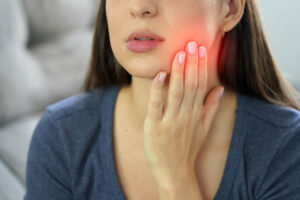
Could Your Jaw Be Behind Your Migraines? The TMJ Connection Explained
If you live with migraines, you know how much they can take over your life. The throbbing pain, sensitivity to light and sound, and nausea can leave you sidelined for hours or even days. While migraines have many potential triggers, there’s one you may not have considered: your jaw. Research suggests a strong link between migraines and temporomandibular joint (TMJ) dysfunction, and TMJ therapy may help bring relief.
What Is TMJ Dysfunction?
Your temporomandibular joints connect your lower jaw to your skull, allowing you to talk, chew, and yawn. When these joints or the muscles around them become inflamed, strained, or misaligned, it’s known as TMJ dysfunction, or TMD. Common signs include jaw pain or stiffness, clicking or popping when you open your mouth, facial soreness, and teeth grinding or clenching, especially at night.
The Link Between TMJ Problems and Migraines
A study out of the University of São Paulo in Brazil found a striking connection between the two conditions. Every participant with chronic migraines showed signs of TMD, compared to 80% of those with occasional migraines and just over half of those without migraines. Patients with chronic migraines were also about three times more likely than those with episodic migraines to report severe TMD symptoms.
Researchers don’t believe TMD directly causes migraines. Instead, they suspect it may make attacks happen more often or feel more intense. Constant pain signals from a strained jaw joint may keep the nervous system on high alert, making the brain more sensitive to pain overall. Tension in the jaw muscles can also send pain radiating to the temples, forehead, and neck.
Signs Your Jaw May Be Contributing to Your Headaches
Your migraines may have a TMJ connection if you also notice:
- Waking up with headaches or a sore jaw
- Clicking, popping, or grinding sounds when you chew
- Pain around your ears, temples, or cheeks
- Worn, chipped, or sensitive teeth from grinding
- Difficulty opening your mouth fully
How a Custom Oral Appliance Can Help
One of the simplest and most common treatments for TMD is a custom oral appliance, sometimes called an occlusal splint. This removable device fits comfortably over your teeth and is typically worn while you sleep. It gently repositions your jaw to take pressure off the joint, relaxes the surrounding muscles, and protects your teeth from the effects of nighttime grinding and clenching.
By easing the strain on your jaw, an oral appliance may help reduce the frequency and intensity of TMJ-related headaches and migraines. Unlike over-the-counter night guards, a custom appliance is designed specifically for your bite, so it fits better and works more effectively. Best of all, it’s a nonsurgical and completely reversible treatment option. If you experience migraines, it’s still important to work with your doctor as well, since several factors can play a role.
About the Practice
At Ponte Vedra Complete Dentistry in Ponte Vedra Beach, FL, Dr. Eric Townsend and Dr. Kristopher Harth take a conservative approach to treating TMJ dysfunction, starting with the simplest solutions first. Dr. Townsend has been caring for smiles since 1985 and is a member of the Dawson Academy Alumni Association, while Dr. Harth has earned a Mastership from the Academy of General Dentistry. To find out if TMJ therapy could help you, call (904) 285-7711 or contact us online.